Round and polygonal barns
Round, eight-sided or twelve-sided, often with a silo in the middle.
How to know it
Round, octagonal or twelve-sided walls under a cone-shaped or many-sided roof. Later ones were built around a center silo so feed sat close to every stall.[1][2]
Where it came from
The Shakers built one in Massachusetts in the 1820s.[1][3] Agricultural colleges later promoted the plan: a 1910 University of Illinois bulletin argued a rectangular barn cost 34 to 58 percent more in materials for the same space.[2] Not everyone agreed; Pennsylvania's preservation office calls the design hard to build and never widely adopted.[4] Indiana was a round-barn stronghold. The Fulton County Historical Society says Indiana once had about 225 round barns and calls Fulton County the Round Barn Capital of the World;[3] a statewide survey by John Hanou counted at least 266 round and polygonal barns built before 1950, with 71 still standing in 2020.[5] The Littleton barn near McCordsville (1900) is called the state's largest, at 102 feet across.[5]
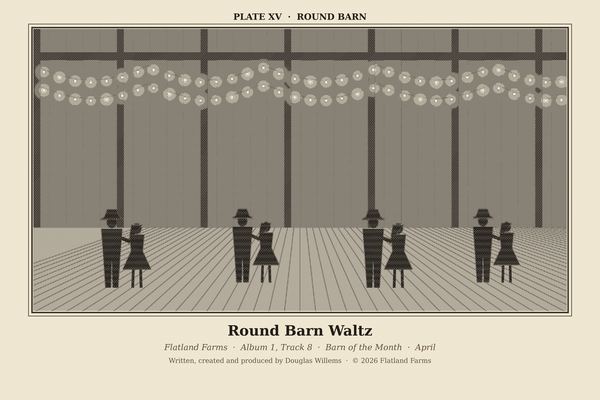 The Flatland Farms plate for this eraPlate XV · Round Barn
Song: “Round Barn Waltz”
Is there a barn like this in your family?
Barn of the Month opens January 1, 2027. Tell us about it now, free, and we will email you the day entries open.
Nominate a barn Record its storyWhere these facts come from
- National Park Service, Preservation Brief 20: The Preservation of Historic Barns (Auer, 1989; copy hosted by Washington DAHP)
- W. J. Fraser, University of Illinois Agricultural Experiment Station Bulletin 143 (1910), via Project Gutenberg
- Fulton County Historical Society, Round Barn Capital
- Pennsylvania State Historic Preservation Office, Field Guide: Barn Types
- Mirror Indy, Indiana barns: restoration, repairs and history
Facts checked October 2026 and written in our own words. If something here is wrong or out of date, tell us through the Barn Letter form and we will fix it. The engraved plates are Flatland Farms artwork, not historic photographs.