Pennsylvania German bank barn
Built into a hill, with an overhang on the downhill side.
How to know it
Two stories with a gable roof. One side is banked into a hill so a wagon can drive straight onto the upper floor. The other side has an overhang, the forebay, that sheltered the stall doors from snow and ice.[1][2]
Where it came from
Its roots are in barns of the high valleys of eastern Switzerland. German-American families carried the form from Pennsylvania into Ohio, Indiana and Illinois, and it was one of the main American barn types before 1880.[1] Animals lived below; hay and grain went upstairs and dropped down to them.[1][2] A close cousin, the basement barn, is open on both sides instead of banked.[3]
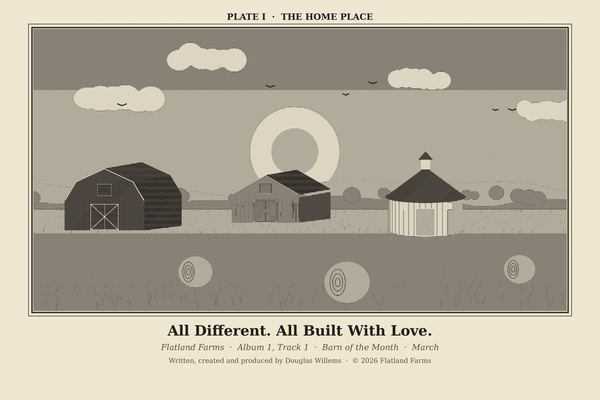 The Flatland Farms plate for this eraPlate I · The Home Place
Song: “All Different. All Built With Love.”
Is there a barn like this in your family?
Barn of the Month opens January 1, 2027. Tell us about it now, free, and we will email you the day entries open.
Nominate a barn Record its storyWhere these facts come from
- The Henry Ford, Firestone Barn: a Pennsylvania bank barn
- National Park Service, Preservation Brief 20: The Preservation of Historic Barns (Auer, 1989; copy hosted by Washington DAHP)
- Towne Post, Johnson County Rewind: Johnson County barns (2018)
Facts checked October 2026 and written in our own words. If something here is wrong or out of date, tell us through the Barn Letter form and we will fix it. The engraved plates are Flatland Farms artwork, not historic photographs.